Best Pictures for a Dating Profile
Which photos to lead with, which to bury, which to delete outright, and how to judge your own set when you are the worst possible person to judge it.
What a dating profile photographer actually does, what it costs, when it is worth it, and the cheaper approaches that get most of the way there.
How to choose a photo when there will not be another one, what to ask for, and the practical decisions that come up when the portrait is a memorial.
What to wear, how to sit, and which conventions in headshot advice are worth ignoring, plus the framing rules that decide whether the photo survives at profile size.
AI music for videos, from someone who scores his own. Why generated tracks fight your edit, how to get one that fits, and the licensing question worth answering first.
What an author photo is for, how it differs from a corporate headshot, what publishers actually need technically, and how to get one that suits the book.
The difference between a model headshot, digitals and a portfolio image, what agencies request at submission, and why the plainest photos are the ones that get you seen.
Why cats are harder to photograph than dogs, how to get a reference shot that works, and what to do about black cats specifically.
Concrete profile picture ideas for professional, social and dating accounts, plus the framing and lighting rules that decide whether any of them work at thumbnail size.
The photo mistakes that ruin dog portraits, how to shoot a reference that actually works, and which styles suit which kind of dog.
What custom pet portraits actually cost, what separates a good one from a bad one, and how to get a photo of your pet that is worth turning into art in the first place.
What an AI UGC creator actually does, what brands pay for the work, which tools matter, and the honest reasons most people wash out in month two.
How many photos to use, what each slot in the set should do, the mistakes that quietly cost you matches, and how to build a set when you barely have any usable pictures.
A working build order for an AI influencer, with the real per-image cost, the consistency problem nobody warns you about, and where most accounts actually die.
The profile photo mistakes most men make, what a good one actually needs to communicate, and how to get one without booking a photographer or asking a friend.
A plain explanation of virtual staging, how it differs from physical staging and from photo editing, what it can and cannot legally show, and when it is worth doing.
What LinkedIn's rules actually say about AI-generated profile photos, where the real line sits between a retouched photo and a misleading one, and how to stay on the right side of it.
A practical guide to clothing, colour, and framing for a professional profile photo, including the specific things that go wrong on small screens and how to avoid them.
Physical staging, virtual staging, and AI room redesign priced side by side, plus the disclosure rules that decide which one you are allowed to use in a listing.
What a professional headshot actually costs once you count the session fee, retouching, licensing, and the reshoot nobody budgets for. Plus where the AI option genuinely fits and where it does not.
See your actual space in a different style before you buy anything. How to redesign a room from one photo while the layout and architecture stay exactly where they are.
You built the persona and grew the following. A brand partnership would validate all of it. Here is how to build a media kit with no track record, pitch brands that fit, and close a first deal without hiding what the account is.
How to get a coordinated wedding stationery suite, save-the-date, invitation, RSVP, and more, that all share one look, from just your names and date.
You do not need a costume budget, a photographer, or sewing skills to see yourself as a character. One selfie is enough to get a full set of cosplay shots.
Bring yourself to the table instead of a stock elf. How to turn a single selfie into a D&D character portrait and sheet that actually looks like you in your class.
Most AI profile pictures give you a good-looking stranger. Here is how to get a set that is stylish and still unmistakably you, from a single selfie.
How to translate and dub a video into another language while keeping the speaker's delivery, so one recording reaches audiences you could not reach before.
Brands need a steady stream of on-brand content and most creators cannot keep up. An AI persona can. Here is how to package AI-generated UGC as a service, what to charge, and how to pitch it without overpromising.
Most AI tarot decks look like a pile of unrelated cards. The reason is style drift, and the fix is to lock one visual language before you generate a single card.
The face is locked, but the setting is doing half the storytelling and most people leave it to chance. Here is how to prompt backgrounds and locations that feel real, stay varied, and never pull focus from your character.
You do not need a studio, a photographer, or a good camera. One clear selfie is enough to get a set of professional headshots that still look like you.
How to narrate a video with an AI voice when you do not want to record yourself. Script tips, voice choice, and the fastest path from text to a finished voiceover.
Connector URL, npx, uvx, or brew. Which install path fits your Claude client, how each one authenticates, and the troubleshooting moves that fix most setups.
Save your brand's voice, palette, tagline, and logo once, then generate marketing images that already look like you. Here is how the Apatero brand kit turns a Claude conversation into on-brand visuals without a designer in the loop.
Generation is the fun part, but a folder of images is not a feed. Here is the handoff loop that turns a fresh batch into scheduled, captioned, cross-posted content without losing a day to the boring middle steps.
The name, handle, and bio do more heavy lifting than most people expect. Here is how to name an AI persona, claim handles that match, and set up a profile that reads as a real account before a single post lands.
Cheaper, faster, always available, never late to a shoot. AI influencers win on some axes and lose on others. Here is the honest comparison of AI versus real influencers on cost, speed, trust, and what brands actually think in 2026.
Connect Apatero tools to Claude Code or Claude Desktop with the Node bridge. Check your account balance and the selected generation cost before running.
You have one good photo of your character. InstaDump turns it into a stack of Instagram-ready posts in one request, same face, varied scenes. Here is how the one-photo-to-many-posts move works from a Claude conversation with the Apatero MCP.
You do not need a fresh photoshoot for every post. One well-planned AI photo set can carry thirty days of content if you know how to slice, caption, and re-angle it. Here is the repurposing loop that keeps a feed alive without generating something new every single day.
Everyone obsesses over keeping the face consistent and then wonders why their AI influencer still looks like three different people. The body drifts too. Here is how to lock height, build, and proportions so the whole person stays the same across a feed.
Traditional shoots run $8K and three days. AI catalog workflow ships the same 30 SKUs in eight hours, solo. The schedule, the prompts, the QA checklist.
A portrait can be ninety-five percent perfect and still read as fake because of the eyes. Here is how to prompt the four details that give AI faces away, and how to fix them when the render still misses.
You already generate stills from a chat. Video is the same move with a different verb. Here is how to turn a saved character into a short clip, or a talking clip, without leaving the Claude conversation.
Not every niche pays. Some look great in a feed and never make a dollar. Here is how to pick a lane your AI persona can own, based on demand, repeatability, and how well the format hides the seams.
Your persona held for forty images and then the face slid off. Here is a calm, ordered way to find what broke, starting with the cheapest fix and only escalating when you have to.
The revenue posts show what an AI persona can make. This is the other side of the ledger. Where the money actually goes when you run one, why the cost structure is nothing like a human creator's, and how to think about margin instead of price.
The difference between an AI portrait that looks generated and one that looks photographed is usually the camera language in the prompt. Focal length, aperture, and framing are the words that turn a render into a photo. Here is the vocabulary that works.
Stop re-uploading the same reference photo into every tool. A Soul saves your character once, server-side, and the Apatero MCP lets you drop that exact person into any new scene from a Claude conversation. Here is how the reuse loop actually works.
A locked face is not a character. What makes an AI influencer feel like a real person is the world behind the face. Here is how to write a persona bible that keeps the voice, backstory, and life consistent across every post.
Your feed is images and short-form is video. Here is how to take one locked still of your persona and turn it into motion, including a talking clip that lip-syncs a script, without breaking the face you spent weeks locking.
The revenue stack tells you the totals. This tells you the individual numbers. How to set a subscription price, what a PPV drop should cost, and how to price custom DM requests so you leave nothing on the table.
The LoRA-vs-IPAdapter decision tree, the page-by-page prompt template, and the rescue strategy for the inevitable page-eight drift in AI children's books.
Once the Apatero MCP is wired into Claude, you never open the studio to make a batch. Here is the exact chat workflow for producing a week of on-persona posts from your locked Soul without leaving the conversation.
The neutral model stare is what makes an AI persona feel dead. Here is how to prompt real smiles, laughs, and micro-expressions while the identity stays locked, so your feed reads as a person instead of a mannequin.
Two base models, two philosophies. Flux gets skin and hands right out of the box. SDXL has the deeper LoRA ecosystem and the speed. Which one to build your persona on, and why the answer is not the same for everyone.
The monetization guides assume an audience. This is how you build one. Platform choice, posting cadence, the persona details that make a cold viewer stop, and the funnel that turns followers into subscribers.
Civitai-LoRA workflow vs Apatero hosted persona lock. Setup cost, identity score, edit speed, ecosystem. The honest decision tree for solo creators.
Lighting drift breaks an image pack faster than face drift. Six lighting locks and the physics-first vocabulary that keeps them stable.
Eight reusable prompt skeletons cover ninety percent of AI influencer posts. Golden hour, mirror, food, gym, travel, work, night, candid.
Stop rewriting pose prompts. Thirty pose references saved as JSON, drop in, the locked character executes. The full library plus the curation logic.
Locked face plus drifting voice equals dead engagement. The five caption patterns that sound like one person across a hundred posts.
A real mascot takes a designer two weeks. With character lock and a style guide, twenty brand-ready renders land in an afternoon. Here is the recipe.
Random outfits per post break recognition. Pick five signature looks, rotate them across every scene, and the character becomes a brand within a month.
Build a complete AI character from one selfie, generate fifty post-ready images, ship a week of content in one afternoon. Real timing, real outputs.
LoRA alone caps near 85 percent identity match. Stack IPAdapter FaceID v2 on top and you cross 95. The exact node graph and the failures to avoid.
Turn one selfie or render into a full turnaround sheet the AI can lock to. Front, three-quarter, side, back, plus expression strip. Real workflow.
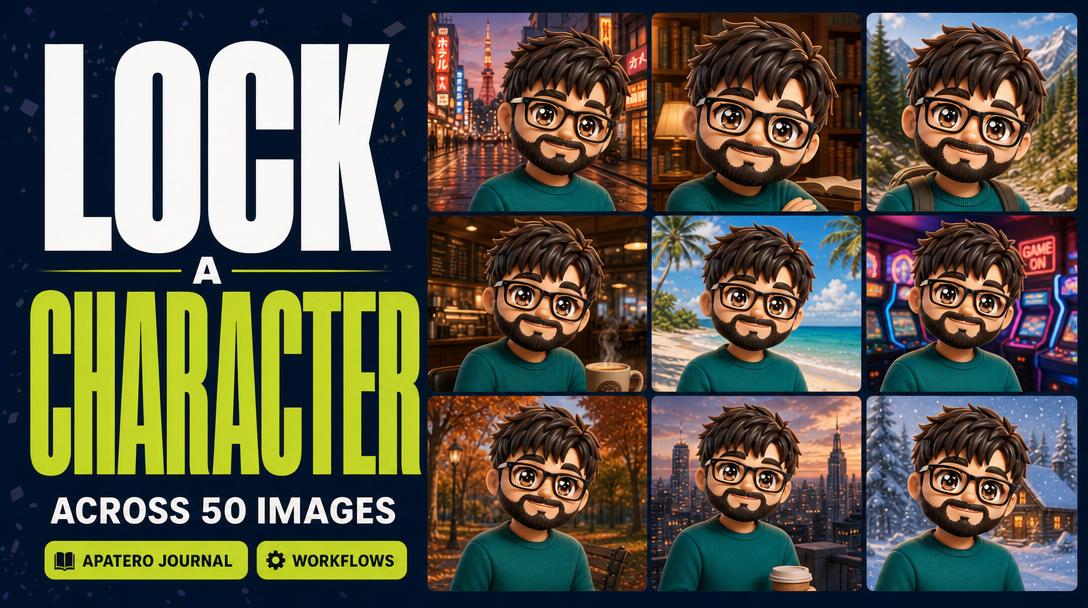
A real workflow for getting the same face, same outfit, same vibe across an entire image set. Without character drift, without re-prompting fifty times